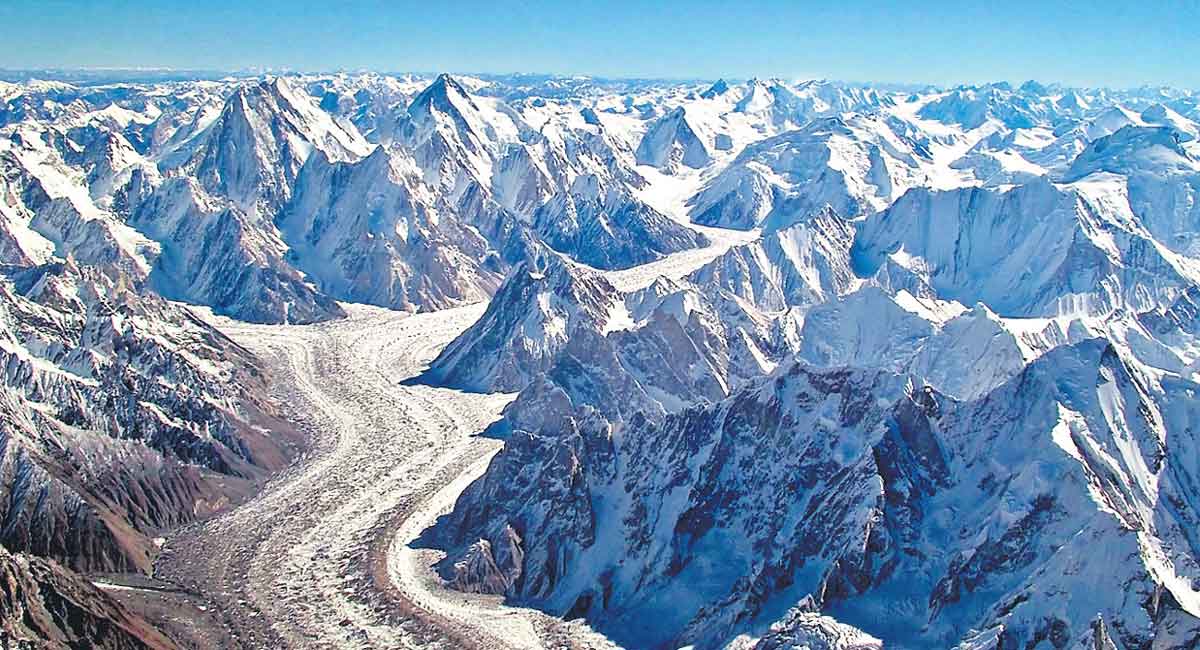
The majestic glaciers of the Hindu Kush Himalaya (HKH), often called the “Third Pole,” are facing a dire future. A new study has revealed that up to 75% of the region’s glacier ice could disappear by the end of this century if global temperatures continue to rise unchecked.
The study, conducted by the International Centre for Integrated Mountain Development (ICIMOD), points to a dramatic acceleration in glacier melt across the HKH region. Compared to the previous decade, ice loss has increased by 65% in the 2010s, driven largely by global warming, reduced snowfall, and erratic weather conditions.
Researchers warn that under a scenario of 3°C global temperature rise — the path currently projected by most climate models based on existing policies — nearly three-quarters of the region’s glacier volume could vanish by 2100. Even under more optimistic scenarios where warming is limited to 1.5°C to 2°C, up to 50% of the glaciers may still be lost. If warming reaches 4°C, over 80% of the ice could melt away.
This vast glacial system feeds 10 major Asian rivers, including the Ganges, Indus, and Brahmaputra, which provide water, food, and energy to nearly two billion people. The consequences of such ice loss could be catastrophic, including widespread water shortages, increased risk of glacial lake outburst floods (GLOFs), landslides, and the drying up of rivers that millions depend on.
Climate experts stress that what is unfolding in the HKH is not just an environmental crisis but a looming humanitarian disaster. Dr. Aditi Sharma of ICIMOD emphasized, “What we’re witnessing is the collapse of a cryospheric system that has been stable for millennia.” Dr. Pasang Sherpa, a Nepal-based researcher, added, “Hundreds of millions depend on these glaciers. Their disappearance will destabilize entire regions.”
The findings highlight the urgent need for bold global climate action to reduce emissions, limit warming to below 1.5°C, and implement strong adaptation strategies in vulnerable mountain communities. With the Hindu Kush Himalaya now at the center of one of the world’s greatest environmental challenges, the call for immediate and sustained action is louder than ever.